

Foucault vs Kuhn
Two influential views on scientific discourse, both denying 'scientific progress'
“It is by questioning the sciences, their history, their strange unity, their dispersion, and their ruptures, that the domain of conditions appeared...” – Michel Foucault
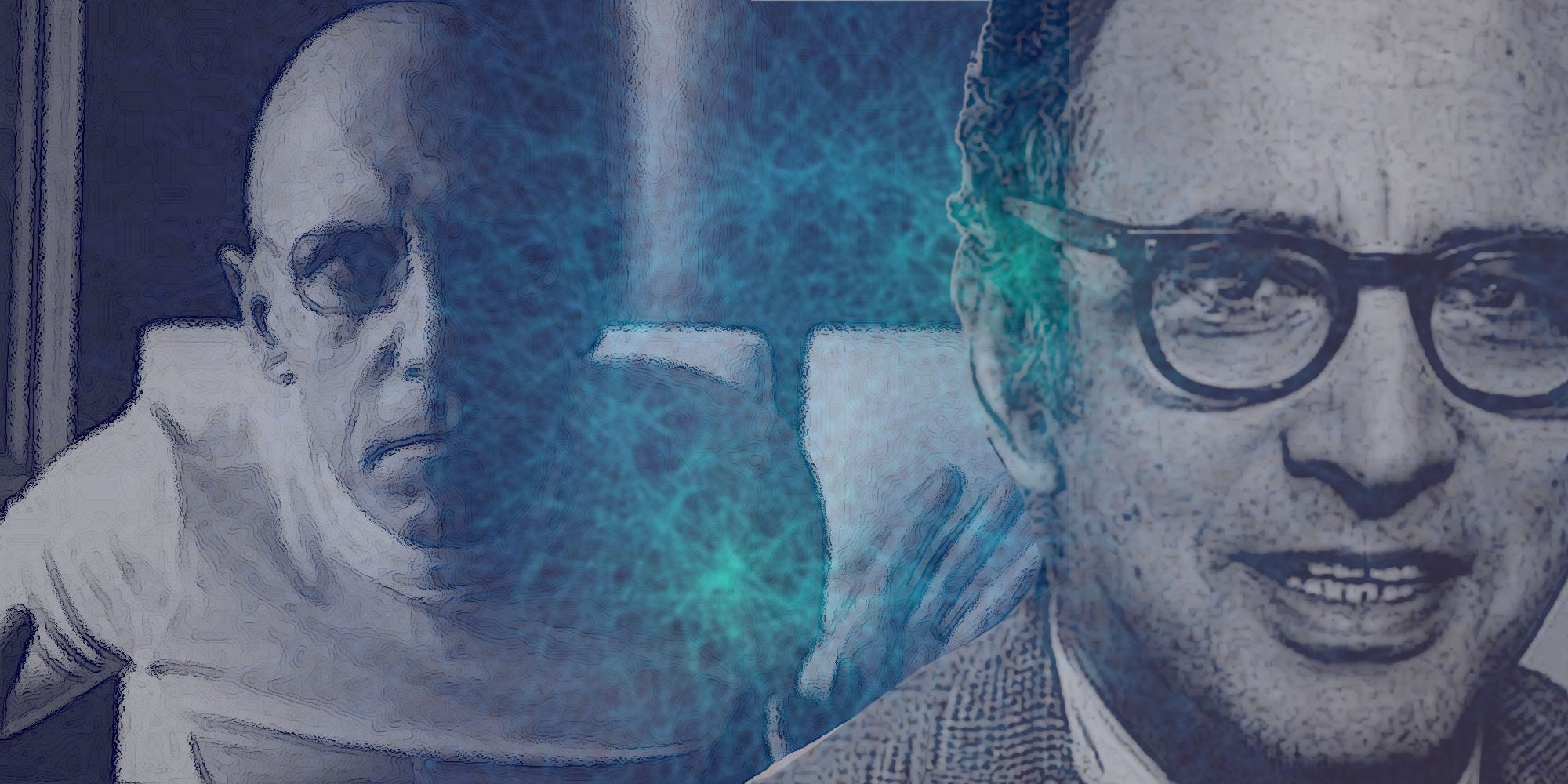
What gives a statement its meaning? The words act as signs with certain implications, and the grammar of the language establishes how those signs can be combined, while the logic of any proposition gives a formal means of relating statements. Yet each of these aspects of discourse is insufficient on its own to explain what happens between and among the statements that are made. What is it that makes some statements into knowledge?
The 1960s saw the publication of two books that took a critical view of the reigning mythos concerning scientific knowledge. The first was Thomas Kuhn’s (koon) The Structure of Scientific Revolutions in 1962, which undermined the idea that the sciences should be understood as progressing towards truth. Kuhn examined the nature of change and constancy in scientific fields and concluded that the rhetoric of inevitable progress was part of the mythology of science. He presented changes in scientific fields as shifts in what he termed a paradigm, suggesting that the appearance of progress was a result of post‑hoc reinterpretations of older theories in terms of those that replaced them.
Scientific techniques do indeed become better adapted to their chosen problems, but just as with biological evolution there is no ‘evolving towards’, only an accumulation of advantages through ‘adapting to’. The danger for post‑Enlightenment myths of progress is that it becomes difficult to separate knowledge from the conditions of its establishment. The idea that scientific knowledge becomes steadily ‘more true’ fails to consider which of the infinite array of possible truths have been selected for investigation. The nature of scientific activity itself becomes obscured.
In 1966, Michel Foucault’s (mee-shell foo-koh) The Order of Things suggested that there had been a series of what he termed epistemes that set the general conditions for knowledge for any given period of time. Kuhn’s paradigms and Foucault’s epistemes are frequently compared, and with good reason. While their specifics differ, both express the idea that the way we understand knowledge is never universal but always historically situated, always conditional upon the prevailing conditions and practices of institutions. One important difference is that Kuhn’s paradigm represents the prevailing conditions of knowledge within a scientific practice, while Foucault’s episteme is a wider construct, the pattern of relations between all paradigms, including those outside the sciences.
In 1969, Foucault followed up The Order of Things with The Archaeology of Knowledge, his only methodological work. In it, he attempted to derive his own methods for historical analysis while expanding upon the concept of episteme. However, The Archaeology of Knowledge was not primarily concerned with epistemes; rather, Foucault focus was discursive formations – the patterns, relations, and networks of practices that connect any given discourse. These are governed by the conditions of knowledge at any given time, and are functionally analogous to Kuhn’s paradigms. For both Foucault and Kuhn, the mythological image of the sciences advancing towards truth obscures the way the sciences renovate their methods and thus their discourse.
I took a particular interest in Foucault’s discursive formations because his analysis took practices as primary. According to Foucault, every practice could be understood in terms of the statements it accepts as knowledge, a process framed by the current episteme but constituted by a complex network of relations peculiar to each field. While he primarily used examples from the sciences, he suggested his method could be extended to politics, ethics, and the arts – anywhere there are practices and conditions governing which statements constitute knowledge.
This serial explores how Foucault’s methods expose the constitution of knowledge in any given context, while representing his ideas in slightly simpler terminology. To begin, we must understand what Foucault’s term ‘discursive formation’ means, which requires dissecting discourse and uncovering the regularities that position some statements (and not others) as knowledge. But because ‘discursive formation’ is painfully obtuse, I shall borrow Kuhn’s term paradigm – not because what Foucault meant was identical to what Kuhn meant, but because Kuhn’s approach is widely understood and Foucault’s is not. By translating Foucault ‘into Kuhn’ (while acknowledging that “all translation is betrayal”, as the Italians say!) I hope to make Foucault’s insights into knowledge accessible to a wider readership.
Next week: Paradigms of Discourse