

Cultural Disarmament
Raimon Pannikar's 1992 book exploring what we must give up to reach peace

“Symbols are the building blocks of myths. With a symbol, one can build many myths.”
– Raimon Pannikar
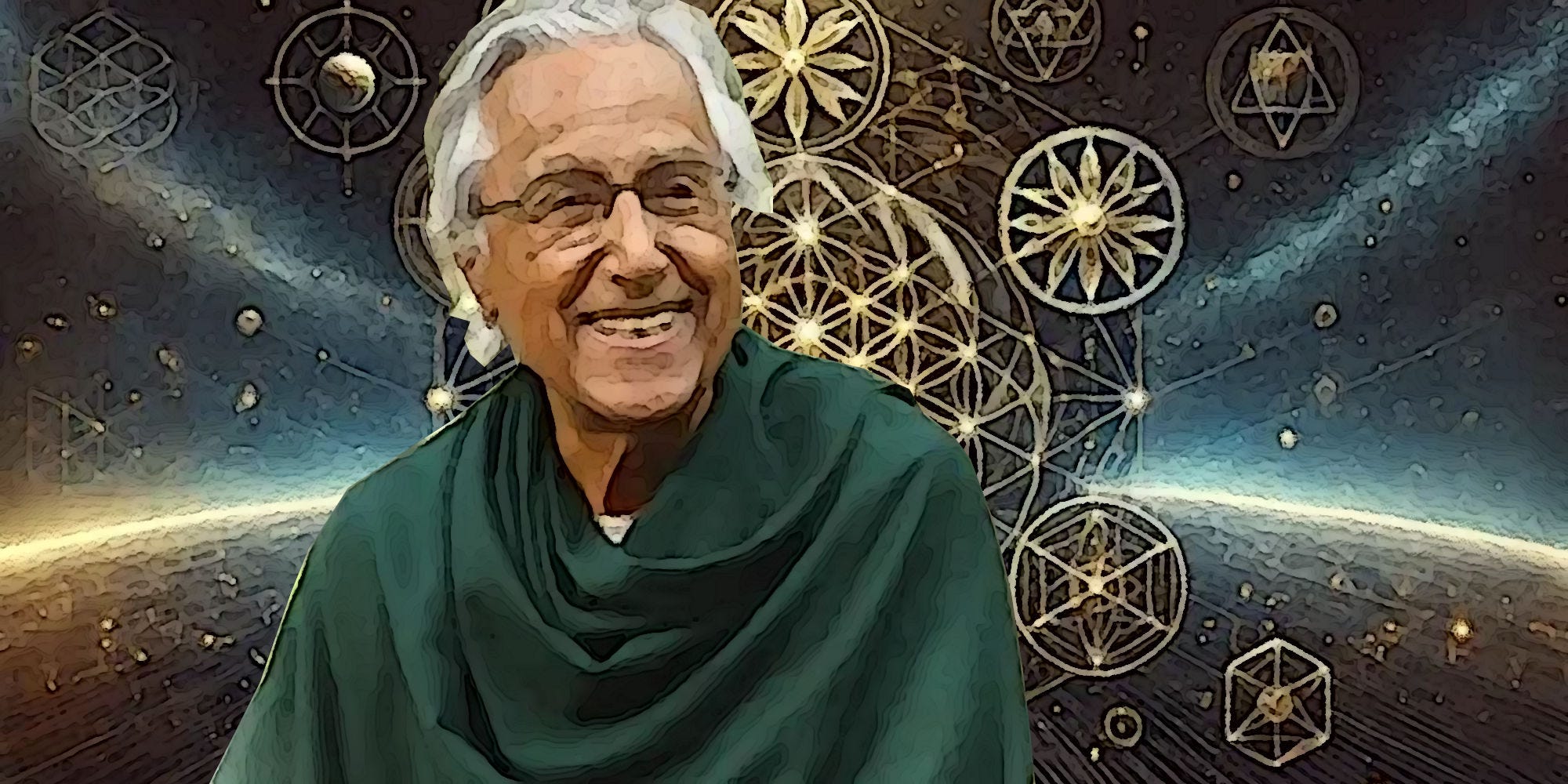
Even the mention of peace has now seemingly left our world. We have gone from wishing for a peace we doubt we can have, to no longer even wishing for peace. Yet if we still desire peace, there are few greater guides to that journey than Raimon Pannikar. His work has been a consistent source of inspiration to me. A Catholic priest and a philosopher, he became a crucial figure in the interfaith dialogue that prospered in the late twentieth century. Upon visiting his father’s homeland of India, he wrote: “I left Europe as a Christian, I discovered I was a Hindu, and returned as a Buddhist without having ceased to be a Christian.”
Like Pannikar, I found a path between religions that brought me to a deeper truth than I could ever have attained within one tradition. Still, at a time when it is fashionable to deny the relevance of any religious tradition, those like Pannikar and myself who have found wisdom within many religions are all too easily dismissed. This presents a substantial barrier to sharing any of Pannikar’s philosophy today: the religious are trapped inside the limits of their faiths, and the non‑religious are wedged inside their box of non‑belief. Small wonder we can no longer find a role for peace!
In the case of Cultural Disarmament, a 1992 book originally published in Spanish, Pannikar’s insistence on treating the question of peace as a religious matter will seem to instantly disqualify his philosophy of peace from further consideration for a great many people. Yet his arguments are sound, his intuitions persuasive, and his programme represents the only plausible path to peace that could be taken seriously. It is harder now to make a call for the kind of disarmament he espouses: so many view themselves as ‘outside’ religion, and thus beyond any thought of being swayed by religious reflections. Yet there is an illusion here. The religious communities Pannikar was writing for in 1992 were no more open to his case than the non‑religious. In fact, both the religious and the non‑religious share the same mythos that Pannikar sought to challenge.
Peace, for Pannikar, is precisely a question of our mythos. It is a symbol rather than a concept, and symbols are “the building blocks of myths”. With a good symbol, one can build many myths, which is to say, mythos for different cultures, regardless whether these are religious or non‑religious cultures. Since the awareness of the role of mythology in human thought has declined along with religious practice, attempts at peace have become more difficult. The non‑religious, after all, are even more blind to their mythos than the religious, and as Pannikar points out, no one is fully aware of their own mythos. Yet this situation is not so different in practical terms, since no culture can claim a monopoly on peacefulness and the name ‘religion’ changes nothing of importance. Regardless of which culture we are talking about, the meanings of the term ‘peace’ rest upon what each culture evokes with this term. This is why Pannikar insists that peace is always a symbol rather than a concept. Cultural disarmament, therefore, necessarily refers to an intercultural striving for peace.
What’s more, cultural disarmament, although it is a call to everyone, is especially a call to us, to anyone who reads this and thus certainly belongs to the predominant international culture, where a veneration of scientific thought and technology is taken for granted. This culture, Pannikar attests, originates in Europe, for all that it is now global in reach. We who belong to it see our values as indisputable and not open to negotiation – even though, as the early years of the 2020s have made clear, we do not agree on the meaning of these values at all. Pannikar was writing in 1992 about the need for the conceptual disarmament of the technocratic culture we all belong to, in order that we might foster peace with all cultures. Today, the same disarmament is also a requirement for peace within our own technocratic culture. The ‘culture wars’ that journalists report on with lurid glee reveal that the problems which prevent dialogue between us and the other nations of the world now also prevent dialogue within our own nations.
Next week: Dialogue Requires Equality