

Cosmopolitics
Isabelle Stenger's philosophy for living in the multiverse

“Cosmopolitics is emphatically not ‘beyond politics’, it designates our access to a question that politics cannot appropriate.” – Isabelle Stengers
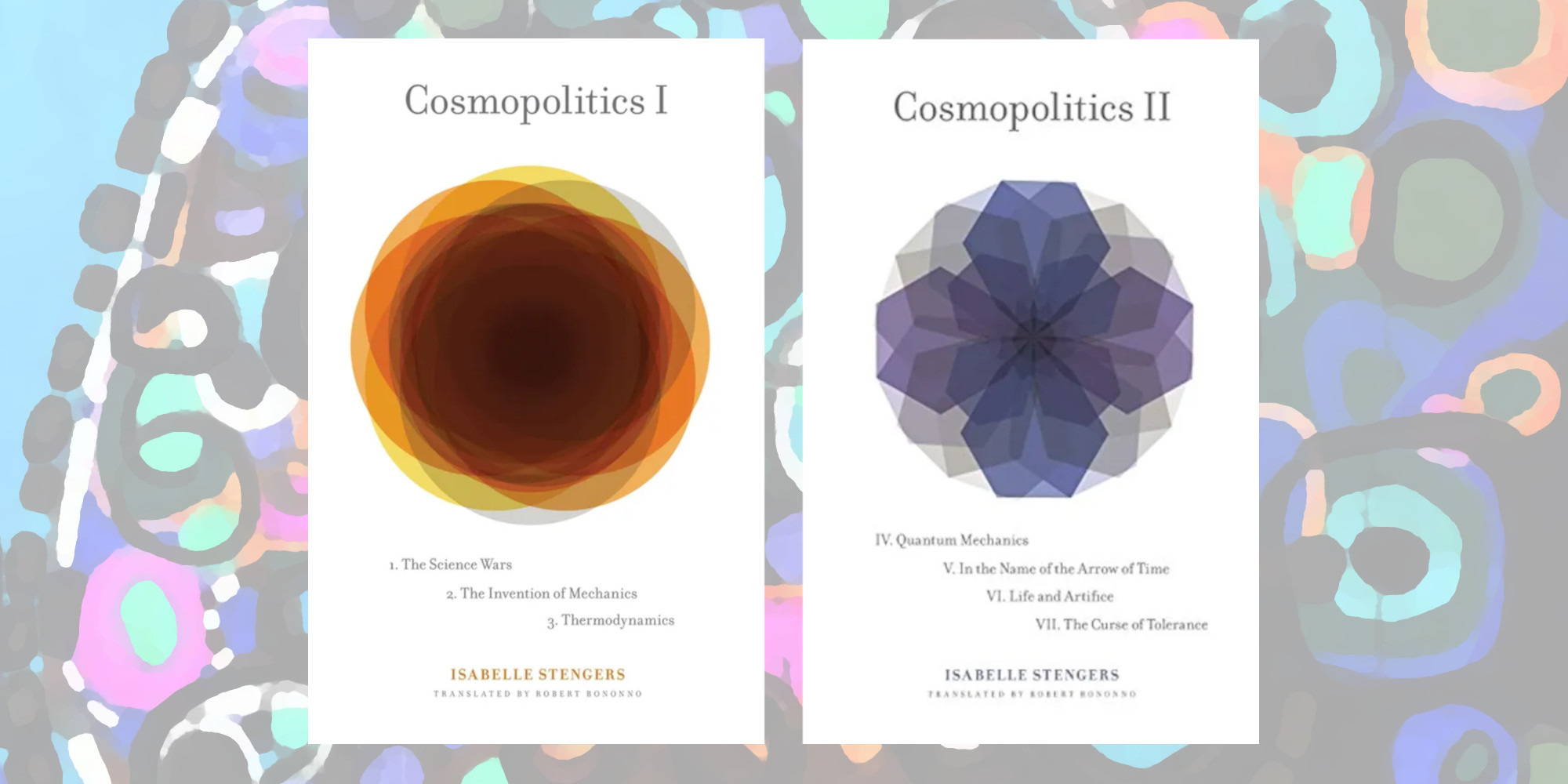
‘Cosmopolitics’ is one of chemist-turned-philosopher Isabelle Stengers’ central ideas. Her work offers a revival of the philosophy of Alfred North Whitehead, and like Whitehead’s philosophy (which his contemporaries simply could not understand!), cosmopolitics can be a difficult concept. Yet if we come at the cosmopolitical having understood Michael Moorcock’s multiverse, having appreciated what William James was attempting with his ‘each-form’ multiverse, it becomes far easier to bring into focus how Stengers approached the fundamental philosophical crisis of contemporary politics.
This catastrophe revolves around our inability to meaningfully talk with others whose world is different from our own. For Stengers, writing across the turn of this century, those we were excluding were the diverse cultures living outside of what is collected under the name ‘the West’. For us, just twenty years later, this impossibility of communication has metastasised and spread within the West, such that half of each nation cannot talk to the other half. This calamity has flowed inevitably from an overly narrow philosophy of science that grew out of the word ‘scientist’ in just a century and a half. It has now seized our political realms and risks their destruction.
The problem is symbolised by the encyclopaedia – that great Victorian symbol of the unity of knowledge. As Stengers challenges in the preface to her epic Cosmopolitics II, no “unifying body of knowledge” can reconcile the neutrino of the physicists with the “multiple worlds” that ethnographers discover by engaging openly with the diverse cultures of our planet. The disparities are too vast for any single system of thought to reconcile them. Yet these immense differences might still be circumvented if we could come together not in a political space, which is inevitably defined by a shared geography, culture, and presumptions, but in a merely-possible cosmopolitical space, in which “the hopes and doubts and fears and dreams” that lie behind neutrinos and electrons on the one hand, and (say) djinn and angels on the other, might come into tentative contact.
This tentativeness, the hesitation, is a key theme in Stengers thought, one that she expressly inherits from Whitehead. His philosophy had committed to patient observation and a resistance to jumping straight to convenient abstractions, committing instead to a kind of speculative openness. Hence his engagement with Einstein’s space-time conceptions from the perspective of ‘what if’ and not ‘this is what is’ (something made possible by Whitehead being one of the most brilliant mathematicians to ever grace the British isles). Hesitation – an alleged demon the contemporary political zeitgeist endlessly tries to banish – is not only necessary if we are to explore knowledge in the pursuit of truth, it enables a kind of ethical experimentation. Indeed, for Stengers, these two aspects are inseparable.
The presumption that our ways of understanding are not only rational, but the only possible rationality is the dark spell under which contemporary politics fractures. Our political realms shear apart because each faction is convinced of its own rationality, despite not being able to agree on either the contents of that rational knowledge, nor indeed the principles that are supposed to bind it! Amongst many examples, Stengers points out that that those who sing the praises of pharmaceuticals (a throng including far more than merely the corporations who manufacture them) presuppose that these are the “only rational” drugs. The presumption that pharmaceutical medicine is rational has until quite recently shielded its advocates from answering legitimate political questions about their deployment and development.
In the enthusiasm that flowed from Enlightenment faith in rationality, we believed that by thinking alone we would become “authors of a utopia that is valid for every inhabitant on Earth”. But this programme could never provide “the ability to meet and recognize those who should be the co-authors of such a utopia.” We crafted a universe, and maintained it by denying the abundant evidence that we actually lived within a multiverse. Cosmopolitics is not another name for this multiplicity of worlds, but rather the name of a way into the multiverse, a path opened by hesitating long enough to avoid rushing towards solutions before we’ve even begun to understand the problems. Within these tangled trails lies the possibility of a future peace.