

Are Numbers Real?
An argument about numbers between two great philosophers sheds light on reality

“The method of ‘postulating’ what we want has many advantages; they are the same as the advantages of theft over honest toil.” – Bertrand Russell
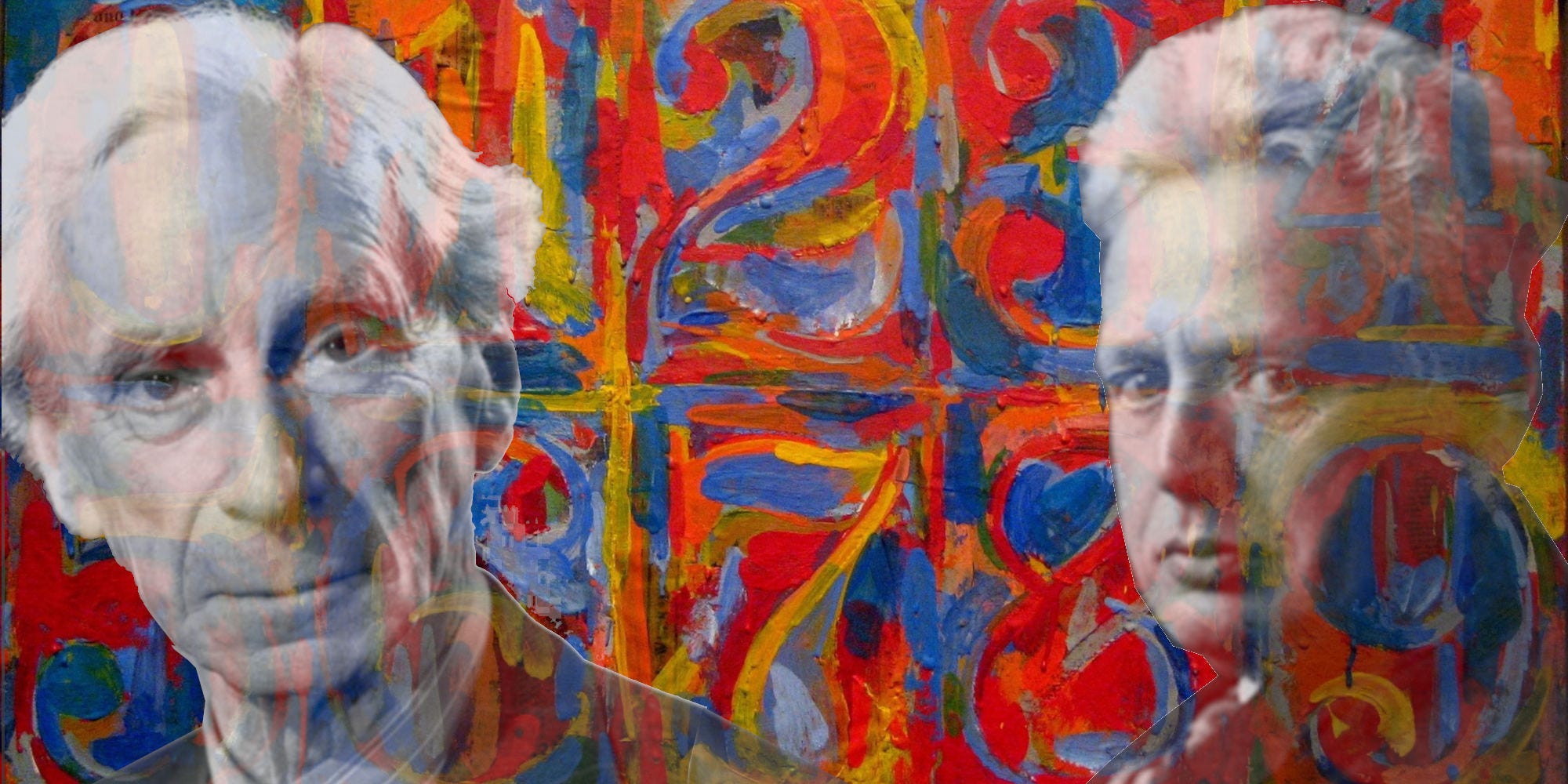
Are numbers real? Our gut reaction is to say that they must be, because whether or not there are a dozen words in a sentence is not a question of an individual’s sense impressions (hallucinations notwithstanding), but rather what we are conditioned to call an objective fact. Bertrand Russell (pictured left), a brilliant philosopher of mathematics and co-author with Alfred North Whitehead of the ground-breaking Principia Mathematica, remained resolute throughout his life that numbers must be real entities. Was he correct?
Russell was a step along the path of the degradation from Immanuel Kant’s philosophy of phenomena and ‘the thing-in-itself’, to the lazy distinction between objective truth and subjective opinion we are lumbered with today. The immense resistance to the idea that reality is a shared project rather than something ‘out there’ entirely independent of the human is rooted in the understandable desire to place reality beyond the human experience. Russell felt this strongly, hence the quote about ‘postulating’ being tantamount to theft. The real, he believed, could not merely be robustly formulated, it had to be ‘out there’ and logical analysis had to be capable of providing methods for verifying its content. Objectivity, according to Russell, was a matter of logic.
The last major defender of Kant’s approach of accepting limits to the real was Ernst Cassirer (pictured right). Whereas Kant claimed the world of phenomena was constituted through conceptual functions inherent to our mental faculties, Cassirer emphasised the role of symbolic and cultural constructions. We experience the real via our methods of understanding what is real, which we share with others through common symbols. Cassirer understood that what Kant had highlighted were the very conditions for knowing, and not a metaphysical split between an objective world ‘out there’ and subjective worlds of individuals.
To understand Cassirer’s approach, we need only look at the example of numbers. Russell was convinced that numbers had to be real, logical objects, definable within a system of logic, claiming that the number ‘two’ (for instance) is the class of all two-membered sets. Cassirer held that there was no need to postulate a metaphysical existence for numbers, since they could be understood as mere functional concepts, symbolic forms whose robustness depended upon their role within a defined system of relationships. For Russell, numbers were real entities that could be ‘discovered’ through logical analysis. For Cassirer, numbers were not like objects at all but simply functional constructs.
These two ways of understanding numbers are evidently incompatible. Russell’s approach made sets primary and real, with numbers derived from sets. Cassirer made ordinal structure (the sequence of counting) primary, with numbers being mere positions in a serial order generated by symbolic rules. Contemporary mathematics has completely vindicated Cassirer’s approach, and the dominant structuralist approach placing numbers into a sequential structure, rejecting Russell’s idea that a number is an object with an intrinsic nature. It is now taken for granted that using set theory to define numbers is essentially arbitrary, since it is the pattern of relations that matters. Numbers, in other words, are not real.
Yet despite Cassirer’s victory over Russell, we remain lumbered with the crude objective-subjective divide, with Russell’s philosophy having further eroded Kant’s insight into the limits of reality. Why? The desire to place reality outside of the human mind while allowing for a privileged back door (logic for Russell, the authority of scientists today) was rooted in hostility to religion. Russell was wildly opposed to Christianity, and expressly desired an end to all kinds of religious belief. Without any trace of irony, he stood on street corners handing out atheist leaflets like a boorish street preacher. Conversely, Cassirer’s philosophy allowed that religious symbols might capture something real... this for Russell (and any others who cannot bear religious viewpoints) would be an intolerable admission.
The fact that we feel so strongly that numbers are real ought to give us pause. It invites us to reconsider the way we think about reality, to acknowledge that our capacity to share mathematical ideas with others constitutes one of the most remarkable (and reliable!) aspects of our shared reality. Cassirer understood this in a way that Russell, for all his genius, never could.
The extension to today's post is "Does Mathematics Exist? and is related to our previous dialogue "Does Dark Matter Exist?".
I have several Mathematician's in my family, and I have occasionally engaged them on the question of "Does Mathematics Exist?". Yes, it is a thought provoking question.
I leave you with a story about MIT Prof Warren Ambrose (https://grokipedia.com/page/warren_ambrose) with whom I sometimes talked when he came to the MIT Swimming Pool as Swim Practice was ending. What amazed me as a physics student was that for Prof. Ambrose, as he recounted his Mathematics, his mathematics was pure abstraction. I realized how differently our minds worked when it came to Mathematics. I am very grateful to Feynman for his diagrams. ( https://www.quantamagazine.org/how-feynman-diagrams-revolutionized-physics-20190514/ )